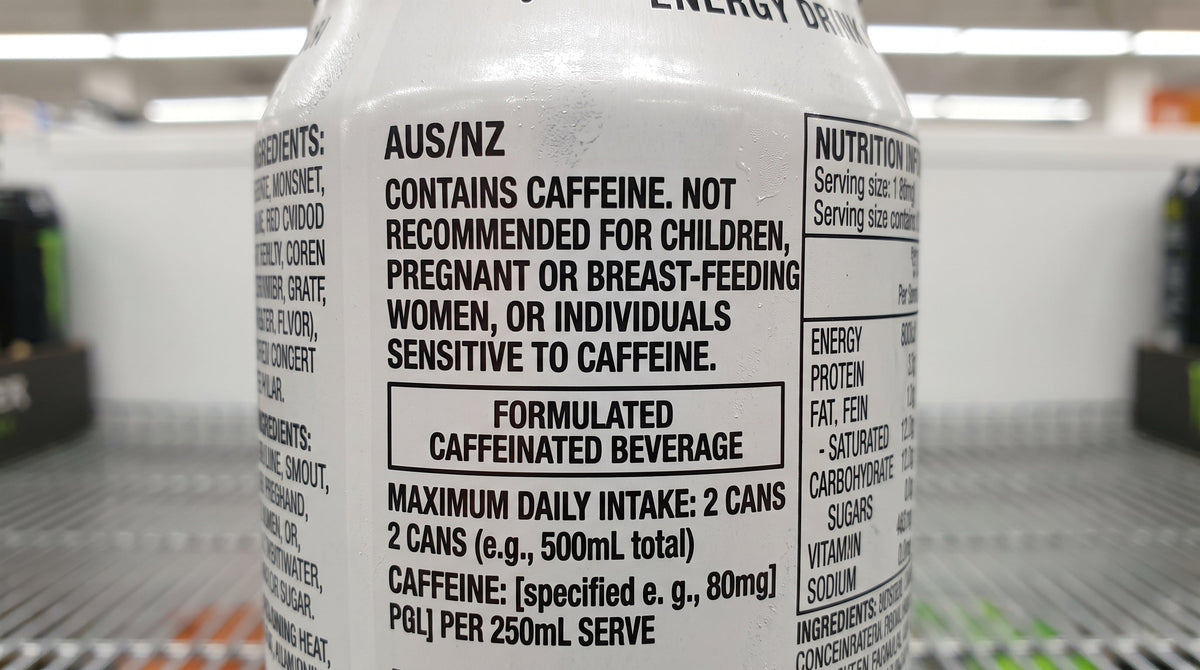
Every energy drink in an Australian fridge is playing by the same rule book. Most people have no idea what's in it.
It explains why the caffeine numbers across brands look so similar, and why every can carries the same warning on the back. Here's the plain English version, updated for FSANZ's 2026 caffeine review.
Who regulates energy drinks in Australia?
Food Standards Australia New Zealand (FSANZ) develops the Food Standards Code, which covers both countries. Energy drinks sit under their own standard: Standard 2.6.4, Formulated Caffeinated Beverages.
State and territory food authorities enforce it in Australia.
Note the name. Legally, it isn't an "energy drink". It's a formulated caffeinated beverage. You'll see that phrase on a lot of cans.
The caffeine limit: 145 to 320mg per litre
Standard 2.6.4 says a formulated caffeinated beverage must contain:
- No less than 145mg of caffeine per litre
- No more than 320mg of caffeine per litre
That counts caffeine from any source. Caffeine added as a powder, from guarana, from green coffee or from tea all go into the same total.
320mg per litre works out to 32mg per 100ml. That's why V, Monster, Red Bull and Mother all land at or within a milligram of 32mg per 100ml. Everyone is sitting on the ceiling.
For comparison, FSANZ caps added caffeine in cola-type drinks at 145mg per kilogram.
So why do some cans have way more caffeine?
Because the cap is a concentration, not a per can limit.
A 250ml can at the cap is 80mg. A 500ml can at the cap is 160mg. Same recipe strength, double the dose.
There's no rule stopping a brand from putting the same concentration into a bigger can. Our caffeine comparison of Australian energy drinks lays out the per can numbers.
What every energy drink label has to show
Standard 2.6.4 has specific labelling rules.
Caffeine and listed substances, per serve and per 100ml
The label must declare the average quantity of caffeine in milligrams, both per serving and per 100ml. The same goes for any "listed substances" in the drink, such as certain vitamins and other added compounds the Code sets limits for.
These declarations can't be buried inside the nutrition information panel. They have to be set out separately.
The advisory statements
The label must include statements that:
- The drink contains caffeine
- The drink is not recommended for children, pregnant or lactating women, or people sensitive to caffeine
- If it contains a listed substance, no more than a one-day quantity should be consumed per day
That one-day quantity is worked out from the limits on the listed substances. Brands usually express it as a number of cans or millilitres per day.
What changed in 2026?
In March 2026, FSANZ approved Proposal P1056, a broad review of caffeine across the food supply.
For energy drinks, the short answer is the existing Standard 2.6.4 rules stay in place. The 145 to 320mg per litre range hasn't moved.
P1056 is mainly about other categories:
- Sports foods can contain caffeine up to 200mg per one-day quantity, with advisory and warning statements
- High caffeine coffee drinks. Packaged beverages with 200mg or more caffeine per serve pick up new labelling requirements
- A general prohibition on adding caffeine to foods except where the Code expressly allows it
FSANZ's approval report gives industry a two year transition period from gazettal. If you're reading this later, check the FSANZ website for the current status.
Is there a safe daily limit for caffeine in Australia?
FSANZ says there's no formal health based guidance value, like an Acceptable Daily Intake, for caffeine.
What it does point to is a 2000 expert working group finding. Increased anxiety was seen in children at around 3mg per kilogram of body weight per day. For adults, FSANZ describes that as roughly 240mg a day, or about three instant coffees.
Other regulators use different figures. The US FDA, for example, considers up to 400mg a day generally safe for healthy adults. We go through the numbers in how much caffeine is too much.
If you've got a health condition, are pregnant or take medication, talk to your GP.
What this means when you're buying
A few practical takeaways:
- Every energy drink on the shelf is close to the same strength. Can size decides your dose
- Read the separate caffeine declaration on the label for the per serve figure
- Check the one-day quantity if the can lists one
- Count guarana and tea extracts as caffeine, because the law does
Our guide to choosing an energy drink for 12 hour shifts covers the rest of the label.
Where TILT sits
TILT is a formulated caffeinated beverage under Standard 2.6.4. Each 330ml can contains 105.6mg of natural caffeine, which is 32mg per 100ml, right on the legal cap.
The difference is the can. At 330ml, you get 105.6mg per serve rather than the 155 to 160mg in a 500ml can.
FAQ
What is the maximum caffeine in energy drinks in Australia?
Under FSANZ Standard 2.6.4, energy drinks can contain no more than 320mg of caffeine per litre. That's 32mg per 100ml.
Is there a minimum caffeine level for energy drinks?
Yes. To be a formulated caffeinated beverage, a drink must contain at least 145mg of caffeine per litre.
Why do energy drinks say not recommended for children?
It's a mandatory advisory statement under Standard 2.6.4. Every formulated caffeinated beverage must state it isn't recommended for children, pregnant or lactating women, or people sensitive to caffeine.
Did the 2026 FSANZ caffeine review change energy drink rules?
No. FSANZ's Proposal P1056, approved in March 2026, keeps the existing Standard 2.6.4 requirements for energy drinks. The main changes apply to sports foods, high caffeine coffee drinks and adding caffeine to other foods.
Does guarana count toward the caffeine limit?
Yes. The limit applies to caffeine from any source, including guarana.
This article is a general summary for consumers, not legal or regulatory advice. Refer to the Food Standards Code and FSANZ for the current wording.
105.6mg per can. No guesswork. Try TILT with the Trial Pack: 4 cans for $24 with a 100-day refund guarantee.